


Originally published on https://groupproject.substack.com/
As someone who has been consulting to large companies for two decades, I have never before seen the excitement that I'm seeing around AI. Typically slow moving companies are racing to find ways to leverage AI and reap the benefits.
This is, nonetheless, a quickly evolving space. As project and program managers, you will likely get pulled in to help get these efforts off the ground and guide them as they move forward.
As you think about how to structure things, here's a tactical guide to help.
1️⃣ The right governance structure is critical
Any experienced project manager knows how important strong governance is to a project’s success.
As you think about standing up an AI program, it’s really important to strike the right balance of control over scope, risks, and budgets without stifling the ability to experiment and learn.
One option that has worked well is centralizing core governance functions but pushing execution to the individual business group level.
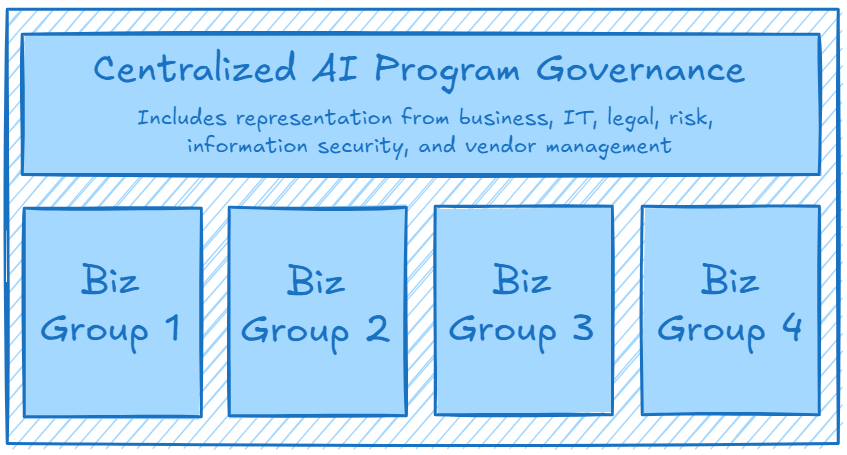
This centralized body wears two hats:
First, it sets AI standards and policies for the organization, develops program-level project management and change management processes, and approves projects and funding. This way everyone is following the same playbook and you avoid the risk that someone in one group is duplicating the work of a team in another.
Second, it needs to evaluate proposed projects through the lens of risk to the organization.
Given the functions of this governance body, it needs representation from your business organizations, IT, Legal, Risk, Information Security (Infosec), and Vendor Management.
The dynamic of these different areas looks something like this: Senior leaders from each business group act as sponsors of the use cases and are accountable for outcomes. IT partners with the business to implement the use cases. Legal, Risk, and InfoSec assess the impacts of an AI solution. And Vendor Management provides guidelines on any vendor solutions brought in for evaluation.
An experienced program manager facilitates getting this body stood up, manages the meetings this body has, and makes sure the business group teams are following the playbook.
2️⃣ First, do no harm: why you need Legal, Risk, and Information Security
Building on the above governance structure, I want to emphasize the important roles of Legal and InfoSec in helping navigate the adoption of AI tools.
First, let’s talk about Legal.
In short: your legal team needs to be involved to protect your organization. This is even more important if you operate across different states or countries, since regulations are starting to form in many jurisdictions and there is more to come. You need to make sure whatever solutions you deploy are not running afoul of any newly minted laws.
There may also be employee policies or guidelines that need to be developed for use of the AI solutions being explored.
Data security and ownership is another important part of the puzzle that should involve a legal review. There may be clauses about whether your data will be used by the vendor to train their model, or whether they can see your prompts or output. This is not something you or IT should navigate alone.
Next, let’s talk about our friends in InfoSec. They’re another important part of the flow since they need to understand what security risks a solution might pose.
For example, people might try to use these tools maliciously. Can your security team see what sort of queries people are submitting?
And AI can make it easier to expose sensitive data. Is data appropriately locked down?
Some solutions might let people exfiltrate data or otherwise set your organization up for a cyber attack.
Needless to say, you don’t want to be the PM whose project put the company at risk.
3️⃣ AI initiatives should be use case based
Every solutions vendor out there is baking AI into their products. You could waste lots of time and money chasing after cool-sounding products that don’t really serve a business purpose for your organization.
Some solutions will be vendor-provided and some will be custom-built in-house, but ultimately the focus should be on use cases anchored to business objectives.
What’s that look like?
Vendor/Product focus: I want to evaluate Workday’s AI features for candidate reviews
Use case focus: Streamline talent recruitment process by automating review and shortlisting of candidate resumes
In this example, Workday may be the solution regardless, but the specific business outcome and value is clearly articulated in the latter approach: it’s not about a tool; it’s about an objective.
As people in various parts of the organization have ideas for where AI might add value, those should get bubbled up to the business group’s sponsor. (Business groups may want their own criteria for defining what goes to the central governance committee for approval.)
4️⃣ The process should optimize for risk management and speed
As mentioned above, there’s a fine balance you’re aiming to strike as you set up an AI program. You need to balance controls with enabling your people to experiment, learn, and deliver value.
Are you doing machine learning? Go anyways.
Just as most PMOs have an intake or business case process to justify projects, you should have a standard form so that use cases can be evaluated consistently. This form should include things like:
Scope of the initiative
What are you trying to learn or deliver?
How is it different from how the business works today?
Expected business outcomes
How will you measure success?
Sometimes it may be necessary to also project the potential dollar value provided. This can be hard to come up with, but something indicative is still useful. For example, is it going to make 10 employees 100% more efficient, or make 1,000 employees 50% more efficient? Some external vendors may have their own studies on outcomes — while these should be taken with a grain of salt, they can still be a useful reference point.
Cost to evaluate or implement the solutions (or to determine what an appropriate solution might be)
Sponsors/owners of the initiative
Here’s how this would look moving through the governance structure:
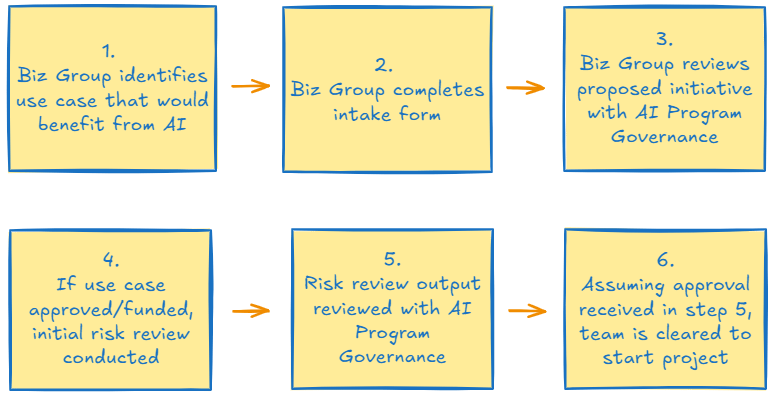
As the project team hits certain milestones you may want them to revisit the program governance forum to ensure continued alignment.
Again, these are high level stage gates and should be tailored to fit how your organization works and what your AI program is trying to achieve.
5️⃣ The landscape is changing quickly; plan accordingly
The tech itself is changing at light speed. Even Microsoft seems to be throwing half-baked products over the fence and then iterating. Finding up-to-date documentation on controls and settings can be a thankless hamster wheel.
What that means for your users is that how something works today may work differently tomorrow. As you think about messaging for your users, you need to set expectations appropriately: it's early days; things will change; we're learning together; we still think these products have a lot of value which is why we're giving them to you.
How you frame this could mean the difference between your users getting frustrated versus understanding it’s all part of the experience adopting a brand new technology.
